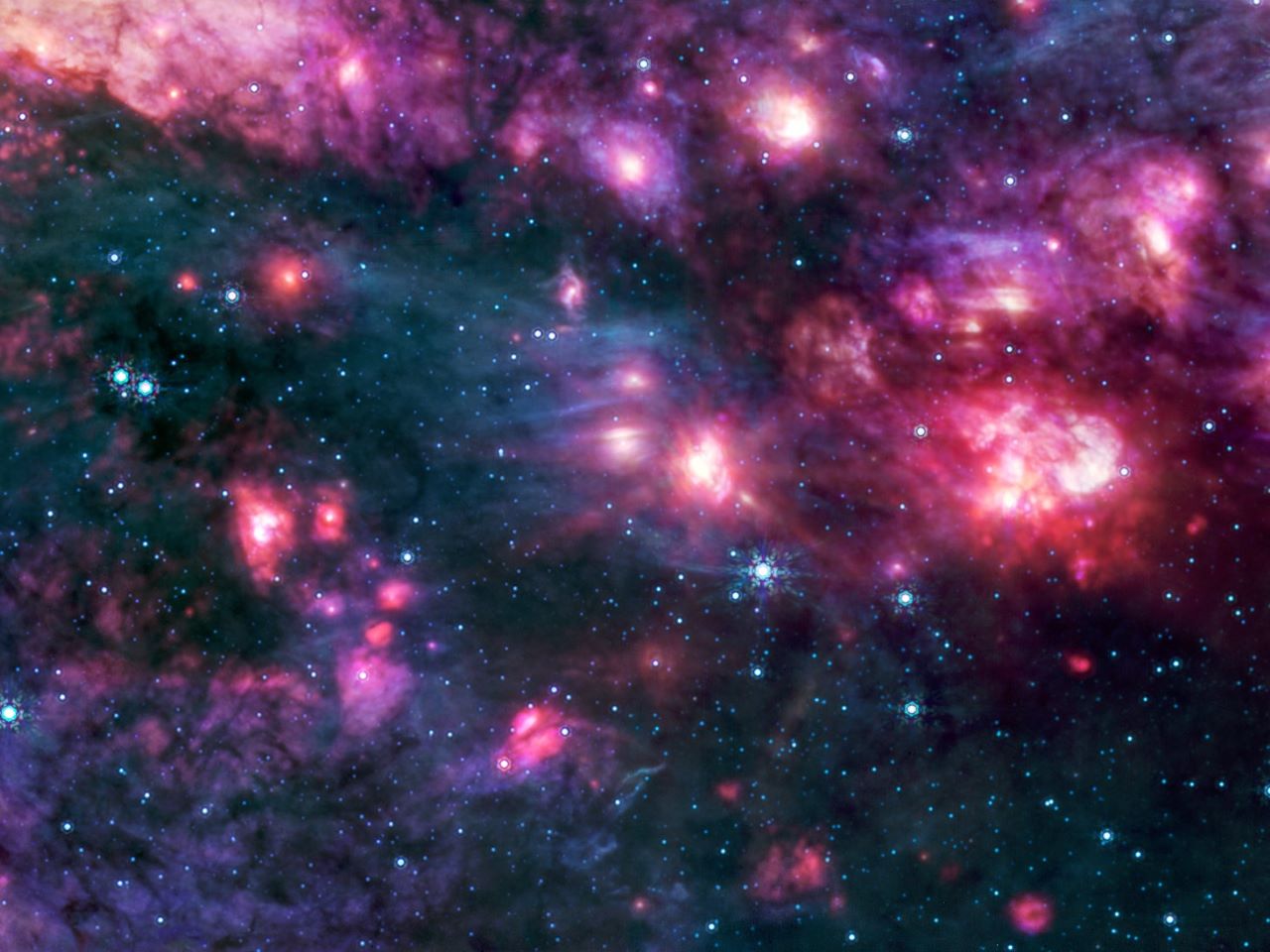
Researchers use James Webb Telescope to reveal hidden details of W51 star formation
- UF researchers used the James Webb Space Telescope to capture visually striking images of the W51 star-forming region.
- The telescope allowed them to see through dust clouds and observe atoms and molecules that are invisible at other wavelengths.
- Young massive stars are generally poorly understood, and the telescope allowed the team to study how these stars interact with their surroundings.
A team of University of Florida researchers used the James Webb Space Telescope to capture photos of a star-forming region known as W51 with never-before-seen clarity and resolution. The long wavelengths of JWST’s infrared technology allowed astronomers to see the stars clearly and show what was previously hidden. Stars in the W51 region are very young and massive, and using the telescope gave the team the ability to view the early stages of star formation.
The telescope’s infrared technology revealed that the stars in the area started forming relatively recently, roughly within the past million years, and are still forming.
This isn’t the first time this region has been photographed and observed. But it may as well be.
“With optical and ground-based infrared telescopes, we can’t see through the dust to see the young stars. Now we can.” —Adam Ginsburg, Ph.D., a professor of astronomy at UF
Before gaining access to this technology, these stars were difficult to see. They are still wrapped in the dust of their birth environment, which obscured the view provided by most other telescopes.
The telescope revealed young stars, including those still growing to their birth weight, that couldn’t be seen before and atoms and molecules that are invisible at other wavelengths.
“With optical and ground-based infrared telescopes, we can’t see through the dust to see the young stars,” said Adam Ginsburg, Ph.D., a professor of astronomy at UF. “Now we can.”
With the region being host to massive young stars, doctoral candidate Taehwa Yoo said the telescope gave the team the opportunity to learn more about the formation of these kinds of stars, which are poorly understood compared to low-mass stars.
Better understanding high-mass stars is extremely important. They interact with neighboring gas and affect nearby star formations, including emitting radiation that heats up their surroundings. The colorful images from JWST show this radiation interacting with the giant cloud.
Stars in the W51 region


“Because of James Webb, we can see those hidden, young massive stars forming in this star-forming region,” Yoo said. “By looking at them, we can study their formation mechanisms.”
The new images reveal massive shocks from protostellar jets, new young stars, giant bubbles and dark filaments. This study revealed some surprises and the research team expects more.
By comparing the JWST images to observations with the Atacama Large Millimeter/submillimeter Array (ALMA), the researchers found that only a small fraction of stars are detectable by both telescopes. This difference shows that, despite the huge improvement in the observations with JWST, there still remains hidden star growth that only radio observations, like those made with ALMA, can see.
Ginsburg and Yoo said the region’s previous photographs were lower resolution and lower sensitivity. With the massive jump in quality in this set of pictures, the team could see thousands more smaller stars and the hot winds that are blowing around them.
The quality revealed more information and showed new structures in the area. They noticed ionized gas bubbles, dust filament structures and an outflow knot left behind by the massive star’s interactions with its environment.
“They are not the first photos of this region, but they are the best,” Ginsburg said. “They’re so much better that they essentially are brand new photos.
"Every time we look at these images, we learn something new and unexpected."