
Meet the UF Croc Docs: Women leading wildlife conservation in the Everglades
- Women make up less than 30% of all scientists globally, a reminder of how persistent gender gaps remain in STEM fields, according to UNESCO.
- At the University of Florida’s Croc Docs Wildlife Research Lab , women represent half of the team, signaling a shift in conservation science as longstanding stereotypes give way to a new generation of researchers, leaders and mentors.
- This International Women and Girls in Science Day, on Feb. 11, meet the women behind the work, whose research and dedication are shaping the future of conservation in the Everglades and beyond.
In chest-deep waters, on midnight airboat runs and along remote roads, women scientists at the University of Florida Institute of Food and Agricultural Sciences (UF/IFAS) carry out the kind of conservation work most people never see.
They capture alligators, track invasive pythons, stop the spread of destructive species and protect some of Florida’s most fragile ecosystems.
They are the ‘UF Croc Docs.’
As part of the UF Croc Docs Wildlife Research Lab, these researchers are redefining what women in science look like in the Florida Everglades and beyond.
For Alexis Pupo and Bryna Daykin, their scientific work starts under a moonlit Everglades sky, where the hum of an airboat cuts through darkness, and a sudden surge in the water signals tactical research is about to begin.
Pupo grips a braided nylon line as Daykin, the boat’s driver and crew lead, eases off the throttle. The alligator they are checking on fights, powerful and unyielding, until the team moves in sync, allowing the animal to tire before securing its jaws and lifting it aboard. Health and measurement data such as length and weight are swiftly recorded. Within minutes, the alligator is released exactly where it was captured. They repeat the process, sometimes 10 times before sunrise.
Scenes like this are routine for the UF Croc Docs, a flagship conservation and research program in which women make up half the team and lead hands-on fieldwork that protects native wildlife, manages invasive species and advances scientific understanding of delicate ecosystems.
For Pupo, a South Florida native, a career in science once felt unrealistic. Like many women in her family, she briefly considered medicine before rediscovering biology during her undergraduate years, inspired by female wildlife professors and peers who shared her passion.
“I can’t imagine a more fulfilling way to spend my time than helping to conserve the environment and the fauna that taught me so much growing up,” she said. “The work I’m doing now allows me to be more involved than I ever thought possible, and I don’t think I’d believe you if you told me in high school that I’d be working on conservation of native crocodilians and management of invasives.”
Then they focus on pythons.
When daylight breaks, the focus often shifts to one of the Everglades’ most destructive invasive threats: Burmese pythons.
Wildlife ecologist Melissa Miller and biologist Michelle Bassis lead efforts to reduce python populations using radio and GPS telemetry, drones and thermal cameras for detection. By tracking tagged male “scout snakes” that naturally seek out large reproductive females, researchers can locate breeding groups and remove multiple snakes at once, reducing impacts on native wildlife. They use data collected on python movement and habitat to inform wildlife management agencies.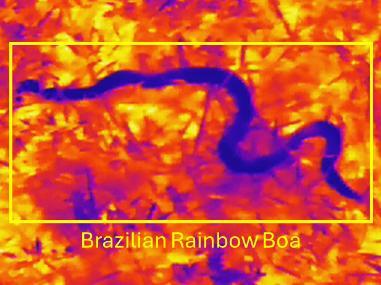
Photo of a preliminary test using a thermal camera to detect snakes. The thermal camera detected an invasive rainbow boa in the Everglades. Photo credit: UF/IFAS Croc Docs
Miller, the project’s principal investigator, became interested in science at the age of 6 during long walks in the woods with her mother. This sparked a love for wildlife, especially snakes, and a lifelong curiosity.
“Women have overcome countless hurdles over the years to even allow me to get to this position, and that is truly awe inspiring and humbling to reflect on -- how decades ago my walk down this path may not have been as easy as a scientist,” she said.
Bassis once imagined herself as a veterinarian or zookeeper before discovering that hands-on wildlife research could directly support conservation.
“It wasn’t until I got to my freshman year of undergrad that I realized working hands-on with wildlife to do research that would make a difference in conservation was a real job prospect,” said Bassis. “I got lucky landing a few jobs with professors on campus doing field work, and that's what sealed the deal for me.”
Today she also leads a comprehensive inventory of mammals, birds and invasive pythons at Arthur R. Marshall Loxahatchee National Wildlife Refuge, helping scientists understand how ecosystems are changing over time in response to invasive wildlife and other human-caused stressors.
Night surveys power conservation discovery.
That team’s work extends onto South Florida roads, where Patricia Rodriguez-Gonzalez and Gabriella De La Fe partner on night surveys as part of the lab’s Everglades Invasive Reptile and Amphibian Monitoring Program (EIRAMP) – the first regional early detection and monitoring program for invasive wildlife in South Florida.
Rodriguez-Gonzalez, who transitioned from volunteer to full-time field biologist, spends long nights driving hundreds of miles across the Everglades, documenting invasive snakes and frogs and collecting data critical to understanding population trends. De La Fe, a Miami native and aspiring conservation scientist, gains hands-on experience in road surveys, python telemetry and trapping of invasive tegu lizards, another ongoing effort of the lab.
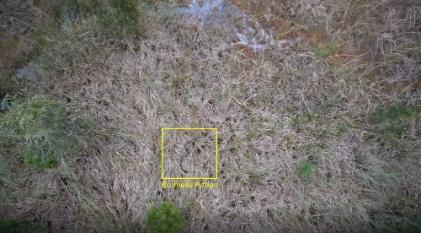 Drone identifies a tagged python part of the telemetry project. Photo credit: UF/IFAS Croc Docs
“Working alongside professional women scientists gave me confidence and motivation to keep moving forward,” De La Fe said. “They’ve shown me that anything is possible.”
International research and much more.
Croc Docs research reaches well beyond Florida. Wildlife ecologist Venetia Briggs-Gonzalez leads international projects on crocodiles, wildcats and the critically endangered Central American river turtle in Belize. Her long-running monitoring program at the Lamanai Field Research Center is rooted in ecotourism that puts conservation first. A recipient of the UNESCO–L’Oréal For Women in Science Award, Briggs-Gonzalez was the first Belizean to receive the honor.
She is making strides on the global front and serves on the Steering Committee for the International Union for the Conservation of Nature (IUCN) Species Survival Commission Crocodile Specialist Group, the leading authority for the status of crocodilians worldwide.
“Girls and young women identify with what I am doing because of the tiny country where I come from,” she said. “They see that there is room for each of us in science.”
Other women across the Croc Docs support conservation in equally critical ways.
Biologist Taylor Brotons is evaluating falconry as a wildlife management tool, while Jen Brueggen, also a biologist, brings decades of crocodilian experience and expertise in wildlife photography and filmmaking to help translate research into compelling public stories.
International graduate student Maria Camila Ojeda Rojas is working to stop the spread of Argentine black and white tegus in St. Lucie County through early detection and removal, including use of automated AI smart traps. She also leads the lab's molecular investigations, identifying novel wildlife parasites.
Laboratory manager Duwa Ansari oversees grants, finances, compliance and logistics, ensuring the science continues while researchers are in the field. When operations are running smoothly, Ansari partakes in field conservation with the rest of the team.
Together, these women reflect the full spectrum of modern conservation science, from field research and data collection to logistics, innovation and communication to strengthening outcomes for wildlife and reshaping what future generations imagine when they picture a scientist.
“People may wonder how we ended up with 50% of our scientists being women in what many still perceive as a male-dominated field,” said Miller and co-leader of the UF Croc Docs. “At every step, we hired the most qualified people based on knowledge, skills, experience and passion. Doing so makes this a richer experience for all of us. But what I really look forward to is a time when women, such as those on my team, can excel in what they do and be recognized without any thought to sex or gender.”