Researchers create DNA detection tool to stop spread of invasive Asian swamp eels, bullseye snakeheads
- University of Florida researchers have developed a DNA-based test that detects invasive species using only the genetic traces left behind in water.
- The newly published breakthrough gives wildlife conservationists a powerful early warning tool to address a major ecological threat, as species such as Asian swamp eels are already established in several Florida waterways and disrupting native ecosystems.
- The team’s digital genetic approach works as a fast, cost-effective and reliable way to spot hidden invaders before they spread.
In the canals, marshes and swamps of the Florida Everglades, invasive fish are silently slipping into new waterways.
Among them are the Asian swamp eel and the bullseye snakehead, two air-breathing predators that live in the region and pose growing risks to native wildlife and fragile ecosystems like the Everglades.
To uncover these elusive invaders, scientists at the University of Florida Institute of Food and Agricultural Sciences (UF/IFAS) have developed a breakthrough approach to detect the cryptic species before they spread farther. The findings, published in the journal of Ecology and Evolution, have broad implications for wildlife conservationists.
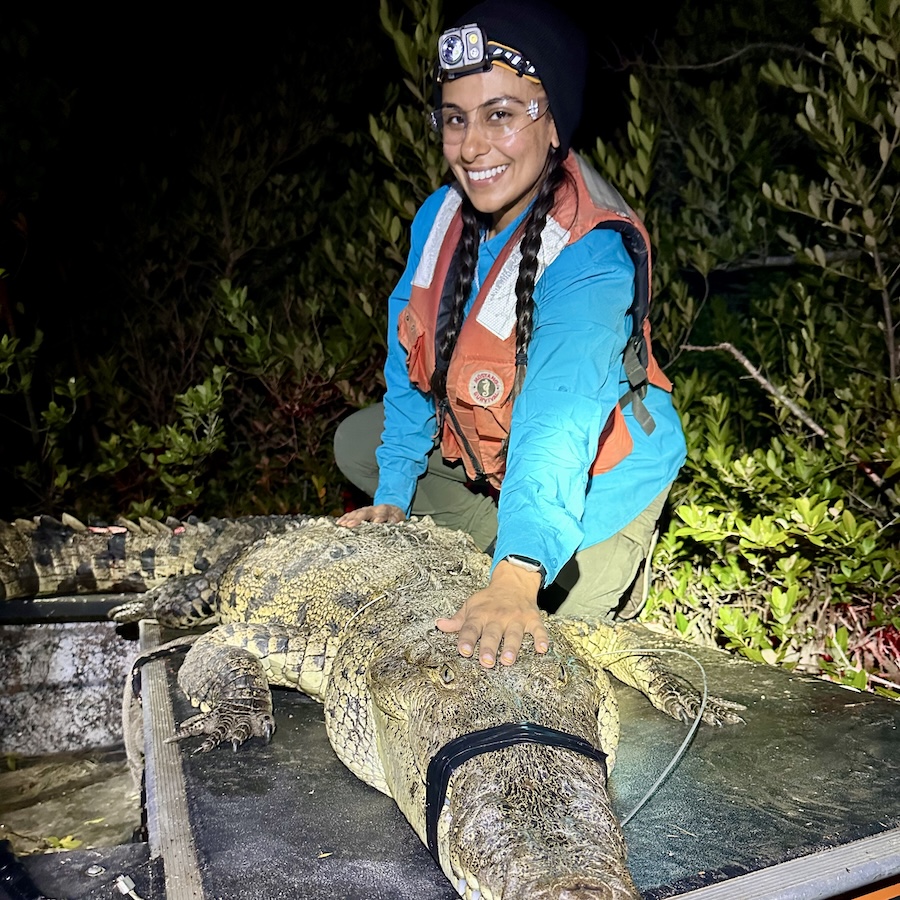
At the UF/IFAS Fort Lauderdale Research and Education Center (FLREC), the Croc Docs Wildlife Research Lab team worked closely with the Bahder Vector Ecology Lab to create a novel environmental DNA-based test that can find these invaders without ever seeing them.
“In this study, we were able to take this new approach and apply it to real-world situations that gave positive results on both species,” said Brian Bahder, associate professor of vector entomology at the UF/IFAS FLREC and the senior author who developed the methodology.
The approach relies on environmental DNA, or eDNA, which refers to tiny genetic clues that animals shed naturally into water, such as flakes of skin or mucus. By collecting small water samples and analyzing them in the laboratory, researchers can identify which species have been in an area, like detecting footprints long after the animal has passed through.
Capable of detecting both species from a single water sample, the test can detect their presence while they remain hidden in the murkiest of waterways. The new tool also has implications for Everglades restoration, one of Florida’s largest ecological recovery efforts.
“A big concern for Everglades restoration is what will happen with invasive species when we succeed, when we get the water right it could boost them to the point we can’t eradicate them,” said Sergio Balaguera-Reina, a research assistant scientist and a member of the Croc Docs. “This is why detecting them, followed by eradication and control efforts as soon as possible is paramount.”
The Asian swamp eel, native to East and Southeast Asia, was documented in the United States in the 1990s. First observed in the southern Everglades in 2007, it has since spread across South Florida. In parts of the Everglades, the species has caused crustacean and amphibian populations to decline, through hunting and competition for food.
The bullseye snakehead, first documented in Florida in 2000, is another large, carnivorous, fish capable of breathing air and surviving in low-oxygen waters. Like the swamp eel, it can survive in canals, marshes and swamps and may move short distances over land to new habitat.
Detecting and removing these fish has long challenged wildlife managers. Asian swamp eels are primarily nocturnal and spend much of the day burrowed into muddy canal bottoms and shallow wetlands.
“Daytime electrofishing, a technique that uses a mild electric current to temporarily stun fish so they can be collected, is the most common method used to detect and remove them, but its effectiveness can be limited because the fish are often hidden during daylight hours, said Melissa Miller, a research assistant scientist of invasion ecology who co-leads the Croc Docs.
To address this gap, researchers joined forces to design and validate a digital PCR approach, a laboratory technique that copies and counts small amounts of DNA with high precision, to detect extremely minute traces of genetic material shed into the water through skin cells, waste and other biological material.
In controlled experiments, scientists detected bullseye snakehead DNA within five minutes of placing a fish in water. Field tests in canals where the species had been observed confirmed that the test accurately identified the species targeted while avoiding cross detection of other common fish and wildlife.
“eDNA analysis by digital PCR is an incredibly powerful approach to invasive species monitoring due to the efficient workflow and high level of sensitivity that allows detection of a single cell in a water sample,” said Bahder.
Because the new test can screen for both Asian swamp eel and bullseye snakehead simultaneously, it offers a cost-effective complement for detection to traditional surveys that require crews, boats and specialized equipment. It can also help wildlife managers evaluate whether removal efforts are working by tracking changes in genetic signals over time.
“Given the strong validation results, we plan to deploy an eDNA sampling network throughout the Everglades ecosystem to evaluate the presence of other invasive species of interest,” said Balaguera-Reina. “However, scientists cannot always sample everywhere, and public involvement in reporting sightings of invasive wildlife and fish remains critical.”
Understanding how invasive species move through the Everglades is a matter of using the right tools, as the eDNA methods developed, and staying in touch with the public, especially those who frequent the Everglades. The research team stresses that every report from the public matters.
Residents can help slow the spread of Asian swamp eels and other invasive aquatic wildlife by reporting sightings, refraining from releasing exotic species into local waterways and supporting effective invasive species management policies. Anyone who encounters an Asian swamp eel or other invasive aquatic species is encouraged to report it to 1-888-IVEGOT1, online at IveGot1.org or through the IveGot1 mobile app.
The research was funded through a UF/IFAS grant initiative, the Support for Emerging Enterprise Development Integration Teams (SEEDIT). It was also funded by the U.S. Army Corps of Engineers and the South Florida Water Management District.