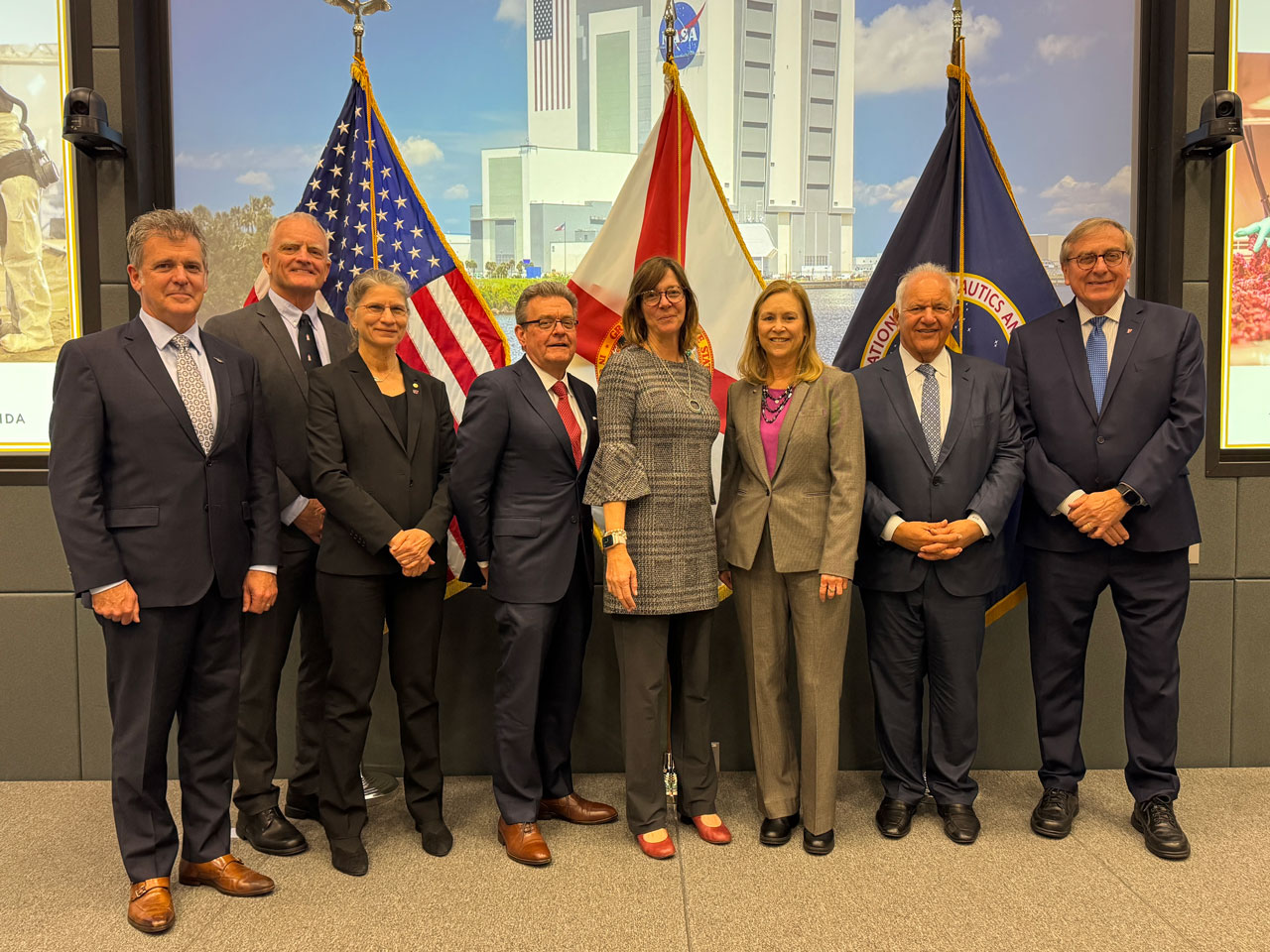
UF researchers collaborate with NASA’s Deep Space Logistics team to reduce and repurpose mission waste
- UF researchers are addressing how to use biomanufacturing to minimize waste generated in space by recycling packing materials.
- This research is bolstered by a collaboration between the Florida University Space Research Consortium with NASA’s Deep Space Logistics Program.
- Researchers are aligning real world impact with research to advance future deep space exploration.
As the number of space missions continues to grow, with hundreds currently active, waste generated during missions has also increased. Cargo packaging materials such as foam and plastic are often used to safely deliver supplies during missions and can contribute to logistical waste over time. Managing waste efficiently is becoming increasingly important as missions grow longer and more complex.
University of Florida researchers are trying to fix this problem.
Nils Averesch, Ph.D., an assistant professor of microbiology and cell science and a member of UF’s Astraeus Space Institute is collaborating with NASA’s Deep Space Logistics (DSL) team to explore innovative biomanufacturing techniques for recycling cargo packing materials from space missions. These techniques use cells and enzymes to break down waste and turn them back into useful materials. This partnership was facilitated through the Florida University Space Research Consortium, which helped connect UF researchers with industry leaders in space logistics.
“It fundamentally shifts our work from conceptual recycling studies to mission-driven systems engineering. With DSL providing insight into what is actually being used in space logistics, we can now size biological recycling processes against real waste streams, real mass flows and real mission timelines. That allows us to scale our research toward integrated, flight-relevant biomanufacturing platforms rather than remaining at isolated proof-of-concept experiments,” Averesch said.
The research focuses on microbial deconstruction and upcycling of plastics, aiming to convert materials typically discarded as waste — like mixed plastics, nylon and foam — into usable resources for deep space exploration. This work could impact future concepts for in-space manufacturing and resource recovery, pending additional research and validation.
“Our job in Deep Space Logistics is to support the commercial supply chain that delivers cargo, supplies and essential materials for our space exploration missions to the moon, Mars and beyond,” said Jeffrey Smith, Ph.D., strategic manager for NASA’s Deep Space Logistics at the Kennedy Space Center. “That’s why we’ve been so excited to collaborate with the University of Florida, the Astraeus Space Institute and with Nils Averesch. His research is helping us better understand how emerging biomanufacturing approaches could one day support sustainability concepts for future logistics missions.”
Resource recovery for deep space logistics missions explores how to use biomanufacturing to recycle the cargo packing materials from missions to space. This work has the potential to transform how we think about sustainability and resource use on long-duration missions.
This collaboration represents an opportunity for UF researchers to apply their work to real-world challenges in space exploration, advancing sustainability and efficiency for future deep space missions. It also highlights the opportunities the consortium can provide to researchers and external partners.
“It is critically important for universities in Florida to collaborate with organizations like NASA’s DSL. These partnerships advance research, strengthen workforce development and support the broader goals of space exploration by helping to drive the commercialization of the space industry,” said Jim O’Connell, interim director of the Florida University Space Research Consortium.